In 2016, the management of STRUKTUM approached me to conduct a practical training on project management using Microsoft Project and MS Project Online. The objective was not only to provide employees with knowledge about the tools, but also to ensure their practical ability to apply the methodology and improve the manageability of projects within the company.
Client Request
The company’s management formulated the following goals:
- implement project management tools into the team’s daily operations;
- master the key techniques of planning timelines, resources, and costs in MS Project Pro;
- train employees to work with MS Project Online as a system for managing project teams;
- develop skills in task, resource, and team workload planning;
- establish clear principles for controlling project execution and analyzing progress;
- improve the quality of project plans and management reporting.
A specific requirement was practical training based on the company’s real tasks, rather than a theoretical overview of the product’s capabilities.
Solution: conducting a practice‑oriented training program
A specialized training program, “Microsoft Project Management Tools,” was developed and delivered for the company, covering three key thematic modules:
1. Key approaches to using MS Project Pro and MS Project Online.
Participants learned both basic and advanced tool mechanics: working with tasks, calendars, dependencies, resources, critical paths, baselines, and progress tracking.
2. Approaches to planning tasks, resources, and costs in MS Project Pro.
Employees learned how to correctly:
- build a project structure (WBS);
- assign resources and rates;
- balance workload;
- create a realistic schedule network;
- manage costs and track actual expenditures.
3. Managing project teams in MS Project Online.
This module focused on team collaboration:
- configuring the corporate environment;
- publishing projects;
- using the resource center;
- working with tasks, statuses, and reporting;
- collaborating via a unified digital system.
Practical focus of the training
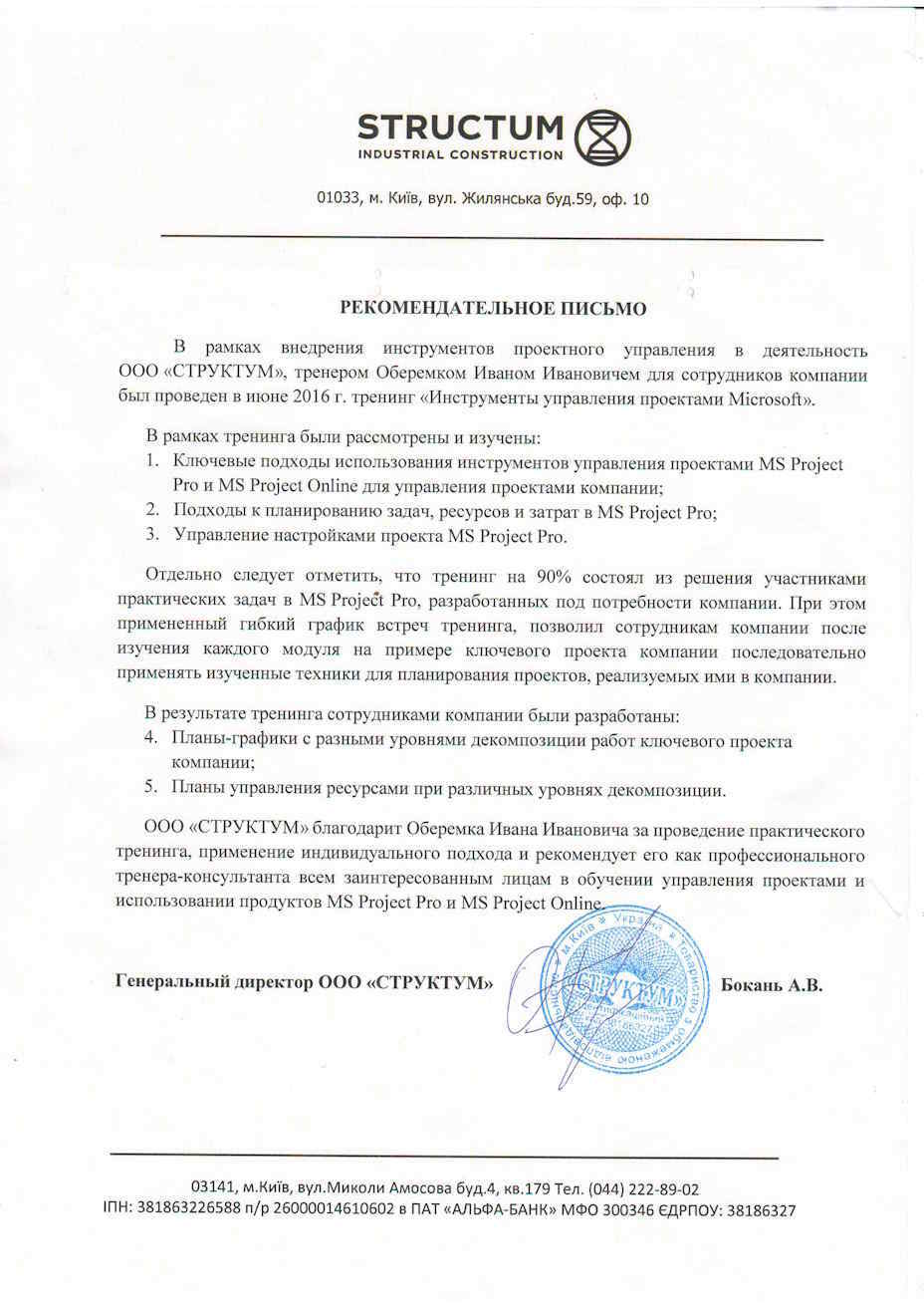
It is important to emphasize that 90% of the training consisted of hands‑on practice, which was also noted in the reference letter.
Employees:
- worked with real company projects;
- built plans from scratch;
- adjusted existing schedules;
- allocated team resources;
- configured reporting;
- learned to identify risks and overloads;
- monitored progress and controlled actual performance.
This approach allowed participants not only to become familiar with the tool, but to acquire real skills that they immediately applied in their daily work.
My role in the project
As part of the engagement, I provided:
- assessment of the employees’ current tool proficiency;
- adaptation of the program to the specifics of the company’s construction projects;
- development of methodological materials and practical cases;
- delivery of in‑person training and individual consultations;
- analysis of real project situations and mistakes;
- recommendations for further development of the company’s project management culture.
My objective was to make the implementation of the tools as practical and beneficial as possible, ensuring a real increase in the competency level of the team.
Project results
As a result of the training, STRUKTUM achieved:
- Significant improvement in project planning quality. Employees began creating structured, logical, and realistic project plans.
- Enhanced control over project execution. The team mastered tools for tracking actual performance, analyzing deviations, and adjusting baselines.
- Effective adoption of MS Project Pro and MS Project Online as corporate tools. Participants confidently use them for teamwork, task allocation, workload control, and reporting.
- Reduced project risks. More accurate planning enabled more effective management of timelines, resources, and budgets.
- Growth of team competencies and project culture. Employees gained professional skills that strengthened overall project management capabilities.
- Practical implementation of the tool in company operations. A foundation was created for further development of the project management office and increased efficiency of all construction projects.
Conclusion
The implementation of Microsoft Project and MS Project Online in STRUKTUM’s operations became a strategically important step toward improving planning quality, resource management, and project team performance. The training provided employees not only with tool knowledge, but with a full understanding of the methodology, enabling them to use the system in real conditions and significantly increase the effectiveness of project management.